
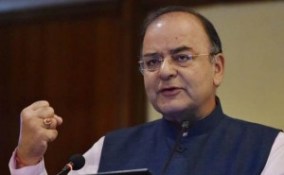

New Delhi, June 26 : Senior BJP leader and Union Minister Arun Jaitley on Tuesday lashed out at the
Left parties for their role during Emergency and pointed out only socialists and RSS among others were in the
forefront of struggle against Emergency.
Mr Jaitley also wondered whether parties like Samajwadi Party of Mulayam Singh Yadav – which inherited the legacy of Ram Manohor Lohia — can truly do any long-term business with the Congress.
“India’s Left parties have always been a puzzle to me. The CPI was an unashamed supporter of the Emergency. Its political line was that Emergency was a war on fascism,” Mr Jaitley wrote in his third and concluding part of his three-part articles on Emergency.
He was also critical of the CPI-M and said, “Though theoretically the CPI (M) was opposed to the Emergency
and critical of it, it was not an active participant in the struggle against the Emergency.”
The Union Minister said only CPI-M MPs were arrested. “Its Politburo members, Central Committee members and students’ leaders were, by and large, not put in detention.”
On the other hand, he said among others — the socialist parties, Swatantra Party, the Jan Sangh and the RSS were the main participants in the Satyagraha and protest against the Emergency.
“To me the Lohia socialist and their post-Emergency evolution has shown a very curious trend. Dr. Ram Manohar Lohia was the creator of the slogan in the early 60s “Congress Hatao Desh Bachao”,” wrote Mr Jaitley and in this context said parties like Samajwadi Party of Mulayam Singh Yadav has inherited that legacy.
“His (JP’s) legacy was represented by George Fernandes, Madhu Limaye and Raj Narain, who were all
consistently anti-Congress. Today that legacy has been inherited by Shri Mulayam Singh Yadav in Uttar Pradesh
and substantially by Nitish Kumar in Bihar. While the trace of anti-Congressism is visible in both, the party
formed by Shri Mulayam Singh Yadav is always willing to do business with the Congress,” he said.
However, Mr Jaitley says: “I have always serious doubts whether those who represent the political DNA of
Dr Lohia and Pt Nehru can in the long run ever work together.”
He added that the most disturbing observation of the Emergency was, “when the Central Government turned dictatorial, the entire system caved in. The Supreme Court became subservient, the media became sycophantic”.
On this backdrop, he said: “Post Emergency L K Advaniji told the Delhi media “when asked to bend, you chose to crawl”.
Moreover, Mr Jaitley said: “Over two lakh false FIRs were registered and hardly any police officers stood up to protest. Thousands of detention orders were passed when there were no grounds of detention. Hardly any Collector refused to sign an illegal detention order”.
Mr Jaitley maintained that the Morarji Desai led Janata Party Government “undid lot of damage” that the Emergency had done so that nobody experiments such dictatorship in future.
The power under Article 352 to impose an Emergency for internal disturbances was now restricted. The courts were given the power of judicial review of several detention orders, he said.
Another significant development, over the decades, has been the “evolution of technology” which has made censorship of the media impossible. “You could no longer withhold information from the people,” writes Mr Jaitley, who also held the portfolio of Information and Broadcasting for a while.
“Though I believe it is impossible for anyone in India to repeat the Emergency, but as the famous advice
goes that democracy lies in the hearts of men and women. When it dies there, no Constitution can save it and no judge can protect it,” Mr Jaitley added.
UNI.

Comments are closed.