
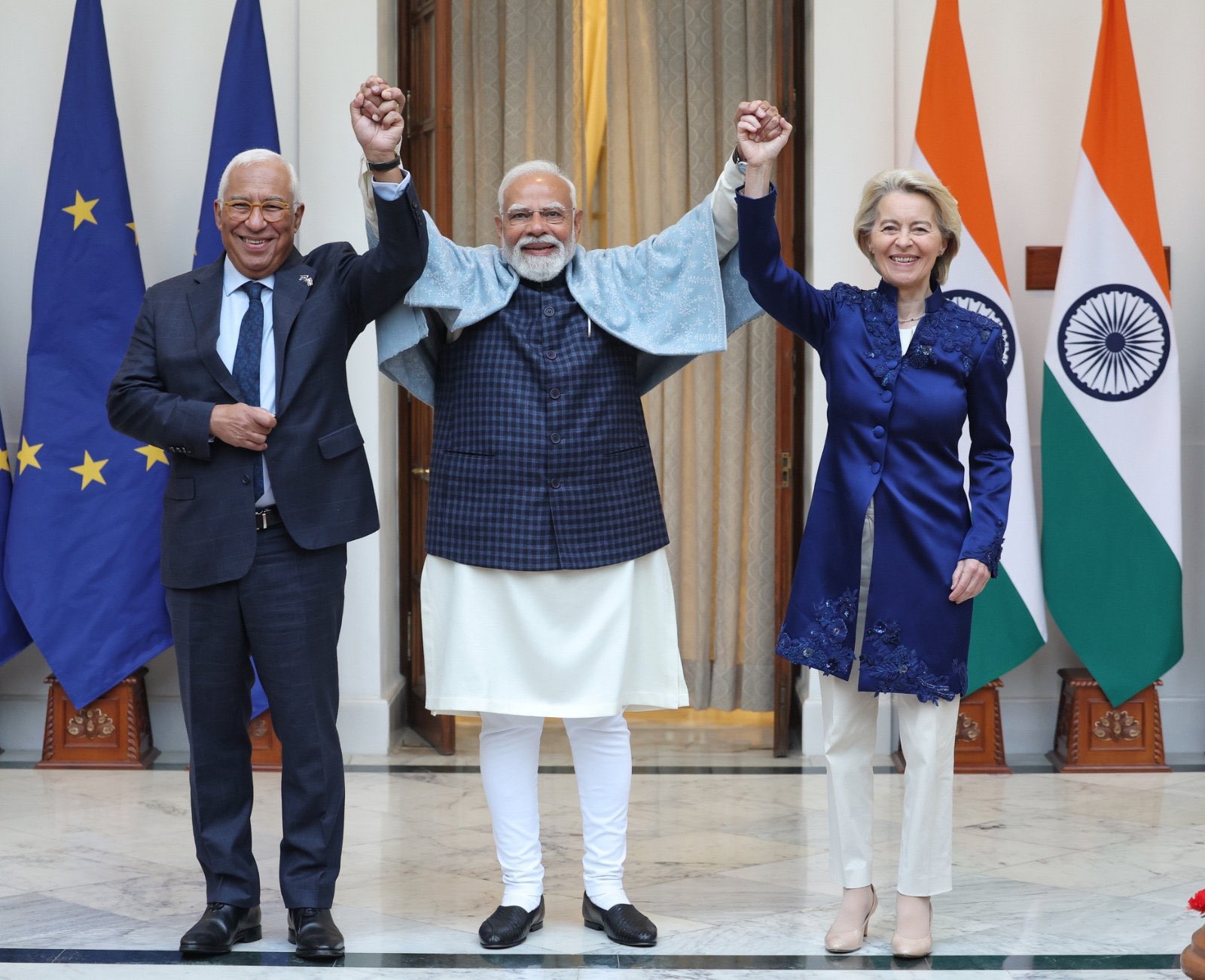

The conclusion of the India–EU Free Trade Agreement (FTA) has drawn strong and positive reactions globally, cutting across international media, foreign political leadership, global business heads, and respected policy experts. The deal is widely being described as historic, strategic, and timely, both economically and geopolitically.
International Media
Leading global media outlets have highlighted the scale, ambition, and strategic timing of the India–EU FTA.
The Telegraph, in an article by James Crisp titled “Modi is real winner in ‘mother of all trade deals’ with EU”, described the agreement as the “mother of all trade deals,” arguing that India has emerged as the real strategic winner. The paper noted that the deal eliminates or reduces tariffs on 96.6% of EU exports to India, while the EU will cut tariffs on 99.5% of Indian goods over seven years.
Bloomberg, in an article by Dan Strumpf titled “All Roads Lead to Modi as World Hedges Trump”, said that the “mother of all deals” concluded between India and the European Union is the latest example of an emerging pattern: New Delhi as the go-to partner for countries.
The Wall Street Journal framed the agreement as a response by middle powers to global tariff disruptions, highlighting how India and the EU are expanding alliances amid uncertainty created by U.S. trade policies.
The New York Times stressed that the deal brings together the world’s largest economic bloc and the fastest-growing major economy after nearly two decades of negotiations.
The Washington Post called it a historic deal with its headline stating: “India and EU clinch the ‘mother of all deals’ in a historic free trade agreement.”
The Guardian referred to it as “Mother of all deals: EU and India sign free trade agreement.”
A similar headline was also reported by the BBC: “India and EU announce ‘mother of all trade deals’.”
Bloomberg, in another article, discussed the possibilities of deeper supply-chain integration, noting that duties on cars will fall as low as 10%, compared to earlier levels of over 100%, and that duties on auto components will be eliminated.
Associated Press highlighted the scale of the deal with its headline stating: “India and the European Union reach a free trade deal representing a third of global trade.”
The scale was also emphasized by Al Jazeera, which said: “‘Mother of all deals’: How India-EU trade deal creates a $27 trillion market.”
Reuters called it a landmark deal, stating: “India, EU reach landmark trade deal, tariffs to be slashed on most goods.”
On Fox News, Pakistani journalist Qamar Cheema said India is set to benefit significantly from the agreement, as tariffs will be reduced to zero in several key sectors. He noted that neighbouring countries like Pakistan and Bangladesh will no longer be able to compete with India in the European market.
Foreign Leaders
Several senior political leaders across Europe publicly welcomed the agreement.
Friedrich Merz, Chancellor of Germany, called the conclusion of negotiations a “very positive sign” and urged swift implementation to boost growth and prosperity.
Alexander Stubb, President of Finland, described the India–EU FTA as historic and the largest trade deal ever concluded by either side, stating that it would significantly intensify economic and political ties.
Ulf Kristersson, Prime Minister of Sweden, said the agreement marks the launch of a new era of cooperation, strengthening prosperity, competitiveness, and security through trade and partnership.
Christian Stocker, Chancellor of Austria, said the deal creates a free-trade zone benefiting two billion people, calling it a major step for Europe’s resilience in a rapidly changing global order.
Lars Løkke Rasmussen, Foreign Minister of Denmark, extended full support to the agreement, calling it geopolitically crucial and highlighting the first-mover advantage in a combined market of two billion people.
Nicolas Forissier, France’s Minister Delegate for Foreign Trade and Economic Attractiveness, termed the EU–India accord a major political step, stressing that “this is not an agreement like the others.”
Sandro Gozi, Member of the European Parliament, said the agreement clearly reflects the EU’s need to diversify partnerships and increase autonomy and independence. He highlighted India as a major global actor, noting that from a geopolitical and diplomatic perspective, the deal opens significant opportunities for both Europeans and Indians.
Business Leaders and Organizations
European and global business leaders operating in India responded with strong optimism, calling the agreement a long-awaited breakthrough.
Jürgen Westermeier, President and Managing Director for India and South Asia at Airbus and President of the Federation of European Business in India, described the FTA as a “big moment” after 20 years of discussions and said it would act as an accelerator of opportunities for both sides.
Wouter van Wersch, President of Airbus International, called it a “fantastic day,” reiterating Airbus’ long-term commitment to Make in India, technology transfer, defence, space, and advanced manufacturing.
Jan Noether, Director General of the Indo-German Chamber of Commerce, said the agreement brings together two billion people and nearly a quarter of global GDP, describing it as the “mother of all free trade agreements.”
Sebastian Stiezel, President of the Berlin Chamber of Commerce (IHK Berlin), described the India–EU FTA as an important step towards opening up in an increasingly tense global situation, noting that India is no longer a future market but a market of the present.
Leading industry representatives, including CEOs from major German carmakers such as Volkswagen, BMW, and Mercedes-Benz, praised the deal’s potential to boost German exports to India and strengthen global supply chains.
The Croatian Employers’ Association (HUP) and BusinessEurope called the EU–India FTA one of the EU’s most important trade moves amid rising global protectionism.
Swedish business organisations such as Svenskt Näringsliv and Företagarna described it as a major opportunity, citing reduced tariffs and improved market access.
Irish economic and business bodies also welcomed the agreement. Chambers Ireland termed it a historic deal that enhances market access and diversification for Irish exporters, particularly in machinery and agri-food sectors.
Other senior business voices, including Frank Schlöder (Managing Director, Häfele South Asia), Thomas Wolter (Managing Director, Krones Machinery India), Lars Eric Johansson (Executive Vice President, Oxea GmbH), Jan-Olof Jacke (CEO, Confederation of Swedish Enterprise), and Fredrik Persson (President, BusinessEurope), welcomed the deal as a strong signal for rules-based trade, supply-chain resilience, SME growth, and long-term competitiveness.
International Experts and Think Tanks
Global policy experts and think tanks described the agreement as substantively strong and strategically well-timed.
Richard Rossow, Senior Advisor at the Center for Strategic and International Studies (CSIS), said the deal brings together a quarter of the world’s population and a massive share of global trade, adding that the positive optics reflect strong substance. He noted that India’s recent FTAs show a clear shift toward deeper and more ambitious trade commitments.
Michael Kugelman, Senior Fellow at the Atlantic Council, called the India–EU FTA the “right deal at the right time,” stressing that it goes beyond cushioning U.S. tariffs and instead consolidates a broader, fast-growing strategic partnership.
Velina Tchakarova, geopolitical strategist, termed it one of the most consequential geoeconomic agreements of the decade, both in scale and strategic intent.
The Kiel Institute for the World Economy said deeper EU–India integration could boost bilateral trade by 41–65 percent and raise real incomes by 0.12–0.13 percent of GDP on both sides.
The European Council on Foreign Relations described the EU–India FTA as one of the largest trade agreements concluded in recent years, covering goods, services, investment, digital trade, and regulatory cooperation.
The International Institute for Strategic Studies (IISS) said India’s recent focus on pursuing trade agreements with multiple partners signifies a move toward a more open economy and will enhance India’s prospects of achieving its long-term development goals.

Comments are closed.