
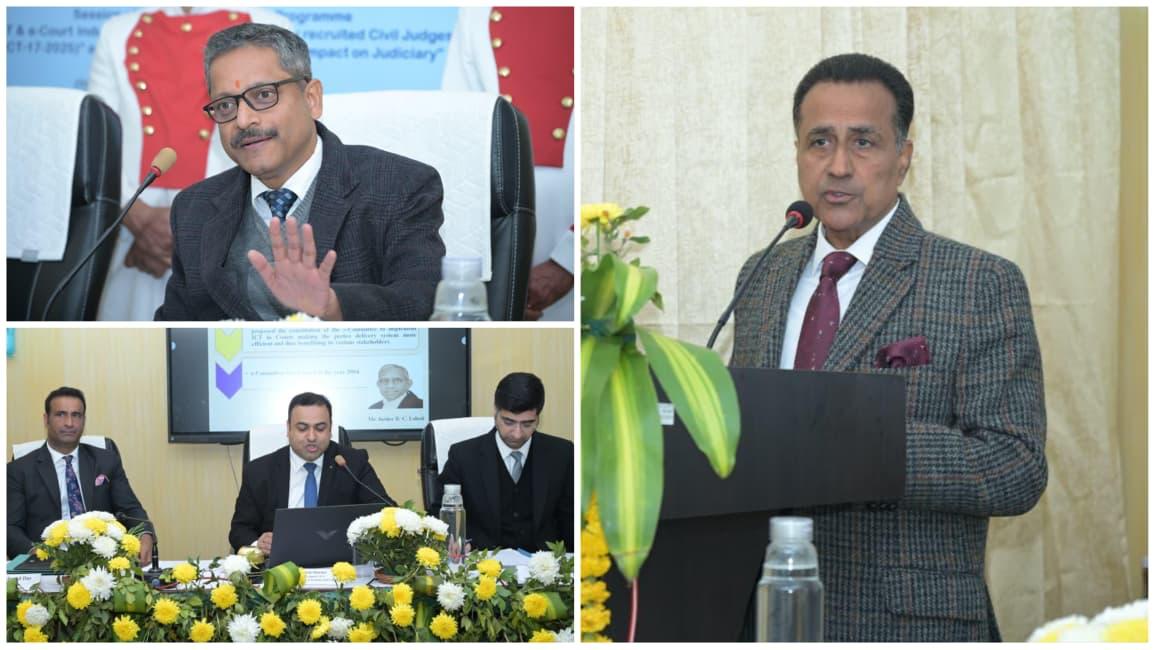

The Jammu and Kashmir Judicial Academy on Friday organised a one-day orientation programme on “ICT & e-Courts Induction Programme for Newly Recruited Civil Judges (ECT-17-2025)” and “Artificial Intelligence and its Impact on Judiciary” at its campus in Janipur, Jammu.
The programme was held under the patronage of Hon’ble Mr Justice Arun Palli, Chief Justice of the High Court of Jammu & Kashmir and Ladakh and Patron-in-Chief of the J&K Judicial Academy, and under the guidance of the Chairperson and Members of the Governing Committee of the Academy.
Inaugurating the programme, Chief Justice Arun Palli observed that the judiciary is entering a decisive phase where technology and justice delivery are inseparably linked. Referring to recent observations of the Hon’ble Chief Justice of India, he said that Artificial Intelligence and digital platforms will increasingly be used for monitoring case pendency, data analysis and case management.
Emphasising the relevance of technology for judicial officers posted in remote and challenging districts, he remarked that technology is no longer merely an aid but a vital instrument for ensuring timely and effective justice. He urged the newly recruited officers to adopt technology with confidence and purpose to strengthen the justice delivery system.
In his special address, Hon’ble Mr Justice Rajnesh Oswal, Judge of the High Court of J&K and Ladakh and Chairperson of the Governing Committee of the Judicial Academy, highlighted the growing use of Artificial Intelligence in adjudication, including assistance in drafting judgments. While acknowledging the merits of AI in enhancing research, analysis and efficiency, he cautioned against over-reliance on technology. Justice Oswal stressed that AI should serve as a supportive tool and not as a substitute for human reasoning, underscoring the need for judicial officers to apply their own intellect and discernment.
Earlier, Director J&K Judicial Academy, Mr Naseer Ahmad Dar, delivered the introductory address, welcoming the dignitaries and participants. He outlined the objectives of the programme, which aimed to sensitise newly recruited Civil Judges to the practical aspects of ICT tools, e-Courts applications and emerging technologies, including Artificial Intelligence. Registrar General of the High Court of J&K and Ladakh, Mr M.K. Sharma, Registrar Vigilance Mr Rajeev Gupta, and other officers of the Registry were also present during the inaugural session.
During the technical sessions, Registrar (IT) of the High Court of J&K and Ladakh, Mr Umesh Sharma, provided an overview of the e-Courts Project and demonstrated key features of the Case Information System (CIS) relevant to day-to-day judicial functioning. Mr Faizan I Nazar, CPC, e-Courts, High Court of J&K and Ladakh, deliberated on ICT-related rules, including e-Filing Rules, Nyay-Shruti Rules, NSTEP and procedures for preparation and supply of copies, including e-True Copies, in the Union Territories of J&K and Ladakh.
In the concluding technical session, Dr Karnnika A. Seth, Advocate, Supreme Court of India, delivered a virtual lecture on “Artificial Intelligence and its Impact on Judiciary”, highlighting opportunities, challenges and ethical concerns associated with the use of AI in judicial processes.
The programme concluded with an interactive session and participant feedback, followed by a vote of thanks by the Director of the Judicial Academy. The event witnessed active participation from newly recruited Civil Judges, reflecting the Academy’s commitment to continuous judicial education and capacity building.

Comments are closed.