
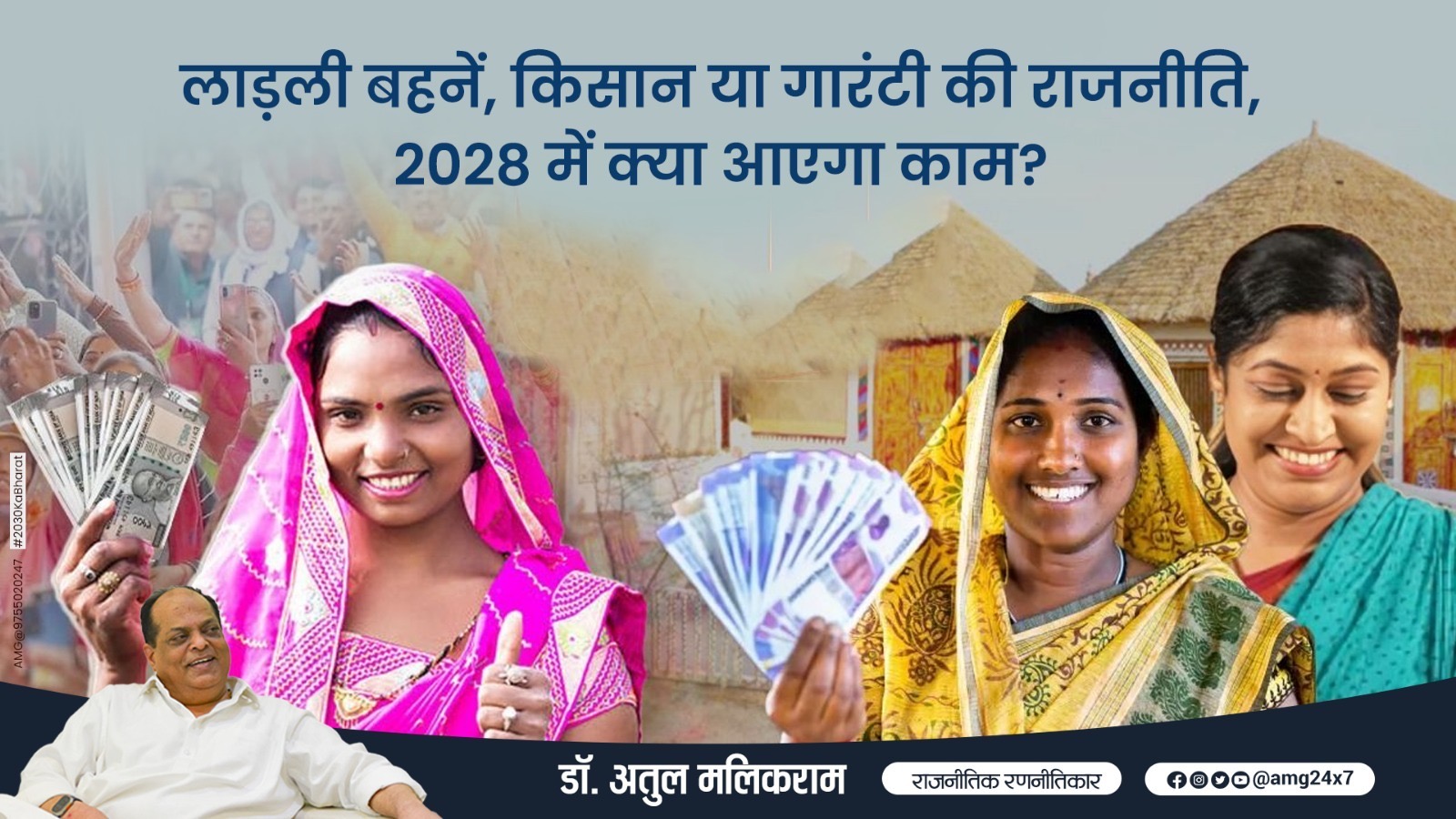
What Will Shape Madhya Pradesh Politics in 2028: Ladli Behna, Farmers or the Politics of Guarantees?

By Dr. Atul Malikram, Political Strategist
As Madhya Pradesh moves towards the 2028 Assembly elections, Indian electoral politics appears firmly rooted in a new reality — one driven less by ideology or rhetoric and more by beneficiary-oriented welfare schemes and guarantee-based promises.
The central political question today is no longer who governs, but which political model delivers consistent, tangible benefits to voters.
The 2023 Assembly elections in Madhya Pradesh marked a decisive moment in this shift. Welfare initiatives such as the Shivraj Singh Chouhan government’s Ladli Behna scheme and farmer-centric programmes not only influenced voting behaviour but reshaped the state’s political landscape. As the next electoral cycle approaches, the debate has sharpened: will established welfare schemes once again determine electoral outcomes, or will the Congress party’s emerging “guarantee politics” disrupt the status quo?
While welfare schemes are not new to Madhya Pradesh, Ladli Behna elevated beneficiary politics to an unprecedented scale. Beyond financial assistance, the scheme offered a sense of dignity, security and empowerment to women. Monthly direct benefit transfers significantly altered household decision-making and strengthened women’s political agency. In the 2023 polls, this translated into a consolidated support base for the BJP among women voters.
A similar dynamic was visible in the agricultural sector. Farmer-focused interventions — including Kisan Samman Nidhi, irrigation expansion, crop insurance, electricity subsidies and debt-related relief — brought relative stability to rural livelihoods. The impact of these measures was visible across villages and markets, reinforcing the perception of a responsive government capable of providing timely support. For many farmers, this immediacy of benefit proved politically persuasive.
In contrast, the Congress party has been advancing a nationwide model of “guarantee politics,” with Rahul Gandhi’s Nyay Guarantee promising ₹1 lakh annually for women, employment assurances for youth, and loan waivers for farmers. In Madhya Pradesh, the Congress is attempting to position these promises as an alternative welfare framework. However, political observers note that credibility and organisational depth remain key challenges for the party in the state.
The 2028 election is thus likely to be a contest of trust. Existing welfare schemes carry the advantage of visibility and continuity, having become embedded in everyday life. Guarantee-based promises, on the other hand, hinge on future delivery. Increasingly, Indian voters appear to prioritise lived experience and sustained benefits over aspirational commitments.
That said, analysts caution against viewing welfare politics in isolation. Rising inflation, unemployment, water scarcity, climate stress, education and healthcare are expected to play a more prominent role in shaping voter sentiment by 2028. The party that successfully integrates welfare delivery with solutions to these emerging challenges may gain a decisive edge.
Women and young voters, in particular, are displaying greater political awareness. Their expectations extend beyond assistance to demands for dignity, opportunity and long-term security.
In Madhya Pradesh, welfare schemes such as Ladli Behna and farmer support programmes have evolved beyond electoral tools into enduring socio-economic drivers. Whether guarantee politics can match this impact will depend entirely on execution and public trust — factors that are likely to define the state’s political trajectory in 2028.

Comments are closed.