
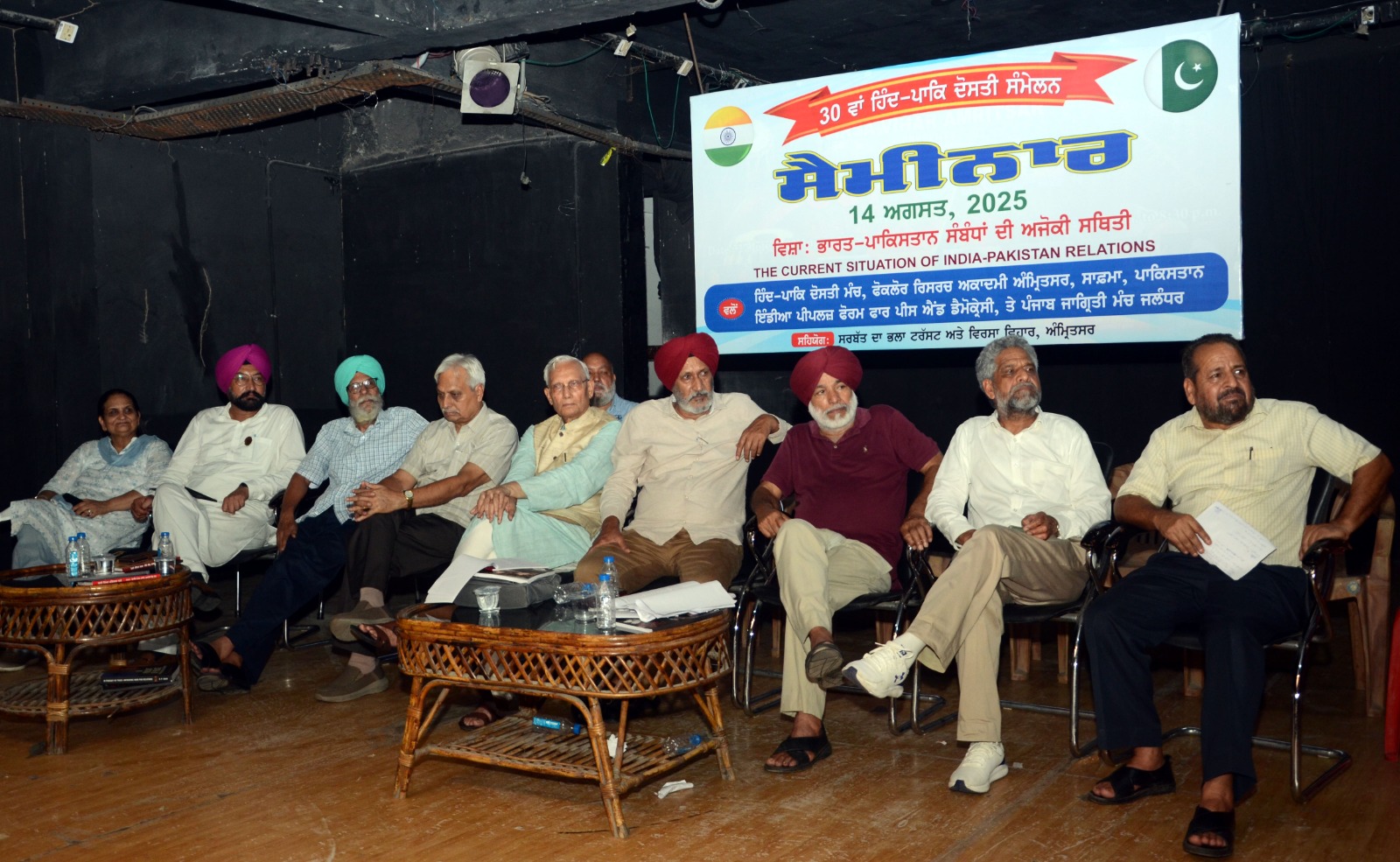

On the eve of the 30th Hind-Pak Dosti Mela, peace activists from India and Pakistan have extended greetings to the people of both nations on the occasion of the 79th Independence Day, while issuing a strong appeal for dialogue, mutual respect and cross-border cooperation.
In a joint declaration released on Thursday, representatives of Hind-Pak Dosti Manch, Folklore Research Academy Amritsar, Pakistan-India People’s Forum for Peace and Democracy, SAFMA and Sarbat Da Bhalla Trust congratulated citizens of India, Pakistan and Bangladesh, and prayed “for a peaceful life and better future of the people of the region.”
The statement paid homage to the martyrs from the three countries who fought for freedom from British rule, and remembered the nearly one million people who perished in partition-related violence in 1947. It also paid tribute to the 26 tourists who were killed in the April 22, 2025 terrorist attack in Pahalgam, Jammu and Kashmir.
Call for dialogue after April clashes
Expressing “deep concern” over deteriorating India-Pakistan relations following a brief four-day armed confrontation between the two countries after the Pahalgam attack, the declaration condemned the incident and urged immediate dialogue. Peace groups appealed to political leaders and military generals on both sides to stop issuing “instigating statements” and to avoid escalating tensions into a prolonged conflict.
They also called on Pakistan’s government to deny any form of support to groups engaged in anti-India activities and to prevent its territory from being used for smuggling narcotics or illegal arms into India via drones.
Minority safety and Nehru-Liaquat pact
The joint declaration raised alarm over “increasing incidents of violence against minorities and forcible religious conversions” in India, Pakistan and Bangladesh. The groups demanded that all three governments uphold the Nehru-Liaquat Ali Pact of 1950, ensuring the security of life and property of minorities and ending any form of discrimination.
Reopening of borders and shrines
The peace organisations urged the governments of India and Pakistan to reopen the Wagah border for trade and people-to-people visits, restoring the pre-restriction visa system. They also called for the Kartarpur Corridor to be reopened for Sikh pilgrims wishing to visit Gurdwara Kartarpur Sahib in Pakistan.
Memorial ‘Peace Parks’ for Partition victims
The declaration proposed the creation of “Peace Parks” on the Attari-Wagah border and on the Bangladesh border in memory of the one million people killed during Partition, “so that the people of three countries may pay obeisance there to those who lost their lives.”
Visas for peace activists
The statement sought liberal visa policies for journalists, intellectuals, artists and other organisations working to strengthen cross-border relations. Such exchanges, it said, would “create the atmosphere of peace” and counter prevailing hostilities.
The groups thanked supporters in India and abroad who have stood by their efforts over nearly three decades. For 29 years, they have organised candlelight vigils on the Attari-Wagah Border each year as a symbolic gesture of friendship.
“This is a shared region, with shared histories, wounds, and futures,” the statement concluded, adding that the only viable path forward is sustained dialogue and joint efforts for peace and development.

Comments are closed.